
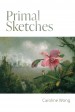
Review of Primal Sketches
“1 - How did your first book change your life? How does your most recent work compare to your previous? How does it feel different?
When I first started writing, sending my work out, I thought that having my first book published would mysteriously change my life in some way. It hasn’t. After the initial surprise and great excitement, life is once again back to its old routines, allowing me to move on to new writing projects. I always enjoy writing, creating; the only difference is that with one book out there, I now throw myself at the task with more confidence and intention.
2 - How did you come to poetry first, as opposed to, say, fiction or non-fiction?
I grew up with little nursery songs and simple chants my mother and grandmother taught us when we were living in China, Later in school we recited poems by the Tang poets Li Po, Du Fu, Wang Wei and others. The magic and musicality of words stayed with me. When I started writing, it was poetry I leaned toward, for its power to encapsulate thoughts, feelings and emotions in a heightened language, with an economy of words I find harder to achieve in prose.
3 - How long does it take to start any particular writing project? Does your writing initially come quickly, or is it a slow process? Do first drafts appear looking close to their final shape, or does your work come out of copious notes?
Once I am inspired and have an idea for a poem, the initial draft is written fairly quickly as my mind goes into that special place of deep concentration. I do edit a bit as I write, but I’d generally let it sit for a while before I go back to revise it. Usually the first drafts appear pretty close to the shapes they finally appear, but sometimes a poem can end up looking entirely different.
4 - Where does a poem or work of prose usually begin for you? Are you an author of short pieces that end up combining into a larger project, or are you working on a "book" from the very beginning?
For me, a poem always comes from the heart first. Words come to me when I fall into a certain mood. I gather them into lines, into short pieces. My first book is composed of poems I had written and put aside, and poems I had recently generated. I’m now working on a new collection of poems with a “book”in mind. So it’s more focused and integrated.
5 - Are public readings part of or counter to your creative process? Are you the sort of writer who enjoys doing readings?
I’m not a public person, but when I have the opportunity, I do read my work in public as a way to take my work out there. It helps to know that I’m not writing in a vacuum.
6 - Do you have any theoretical concerns behind your writing? What kinds of questions are you trying to answer with your work? What do you even think the current questions are?
The concept of art for art’s sake has always intrigued me. Do I strive to create a kind of pure poetry that solely conveys beauty and gives enjoyment? And if it has a social, humanistic, altruistic purpose, does it lower the poem’s poetic value? Mostly, I follow my own inclinations. If my writing can evoke in the reader the same strong emotions and feelings and passions I have for my subjects I would be more than satisfied.
7 – What do you see the current role of the writer being in larger culture? Does s/he even have one? What do you think the role of the writer should be?
I think every person has a role in making the world a better place by speaking out against injustice, inequality, bigotry and violence. Through the pen, writers can speak so much more loudly, their messages more likely heard. By advocating tolerance, fairness, empathy and compassion, a writer can contribute toward making a better future for later generations.
8 - Do you find the process of working with an outside editor difficult or essential (or both)?
It was wonderful working with my editor, Clarise Foster, on Primal Sketches and a great learning experience for me.
9 - What is the best piece of advice you've heard (not necessarily given to you directly)?
Never stop learning. The more we learn, the more we know our own ignorance. Each new wisdom gained humbles us a little more. Tolerance for and understanding of others’ faults and differences comes from knowing that no one is born perfect.
10 - How easy has it been for you to move between genres (poetry to short stories)? What do you see as the appeal?
What I write is mostly motivated by what I read, and other times, by my reflections on the various personal and outside events unfolding around me. Whether I’m writing poetry, fiction, creative non-fiction, all three genres allow me to explore subjects that are important to me: family history, our cultural past, memories of my girlhood in China and in Vancouver’s Chinatown.
11 - What kind of writing routine do you tend to keep, or do you even have one? How does a typical day (for you) begin?
When I’m working on a project, I tend to keep a fairly regular routine. I’d write four to five hours in the morning each day. Then I’d go out for a walk to clear my head. Often though I find the writing continues in my head: reviewing, editing, even when I’m away from the my desk.
12 - When your writing gets stalled, where do you turn or return for (for lack of a better word) inspiration?
I usually re-read what I have written before I continue with more writing. I find this process opens up other possibilities, points to different approaches.
13 - What fragrance reminds you of home?
This may sound strange. The smell of moth balls takes me back to my grandfather’s old desk at home, opening drawers, rummaging through bits of string, old bronze coins, rags, to find a yellowed, string-bound, picture book depicting gruesome tortures that the wicked suffer in Hell. It was the only book I ever came across in the house when I was a child.
14 - David W. McFadden once said that books come from books, but are there any other forms that influence your work, whether nature, music, science or visual art?
Because I spent my early years in a rural setting with open fields, orchards, hills, streams, themes of Nature, memory, journey occupy a large part of Primal Sketches.
15 - What other writers or writings are important for your work, or simply your life outside of your work?
Impossible to name the long list of great writers I admire over the years, but all great writings, whether in English or in Chinese, have a great influence on my work. When I’m not writing, I read, hike, garden, lunch with old friends, travel (before Covid-19).
16 - What would you like to do that you haven't yet done?
Learn to speak Mandarin fluently so that when I travel in China, I would feel less out of place, more at home, if only to fool myself. I know one can never step into the same river twice.
17 - If you could pick any other occupation to attempt, what would it be? Or, alternately, what do you think you would have ended up doing had you not been a writer?
I was at one time working as a Medical Laboratory Technologist. If I hadn’t become a writer, I would probably have gone back to the lab. I liked the the investigating, testing and analyzing aspects of the work.
18 - What made you write, as opposed to doing something else?
Writing enables me to get my stories out and share them with others, as a way to have my voice heard, and also as a means to discover their underlying significance. What they mean to me. Why I feel they are important to me.
19 - What was the last great book you read? What was the last great film?
The Men Who Killed Me. Reading the women’s stories shocked me out of my complacency and narrowness. The world is not getting better and better as I’d thought. Human nature never changes. For the voiceless and defenseless, their stories become a means for them to speak out against violence and abuse, to have their voices heard.
Gravity. Although it takes place 600 kilometers high above Earth, the story’s central theme is very much grounded: a young mother’s journey from grieving for the loss of her daughter to final acceptance.
20 - What are you currently working on?
A collections of elegiac poems on Vancouver’s Chinatown: its scandalous beginning, its heartbreaking decline, personal family history, stories of the girls and women whose lives and mine had briefly commingled in Chinatown.”
Read the full review at Rob McLennan's Blog
More Reviews of this title
“Journeys of all sorts fill the pages of Burnaby-based Caroline Wong’s new collection of poems, Primal Sketches. Wong takes readers stumbling through hiking paths in British Columbia, trudging along the Camino de Santiago, and fleeing down the Yangtze River. She takes readers on journeys through loss, death, diaspora, and finally, hope.
“For me, journeys are acts of expectation, a move toward possibilities and discovery. Over the years, I have taken many journeys, most important of which is my immigration from southern China to Canada when I was young,” says Wong.
Poems such as “What We Carry,” “Where We Land,” and “Ancestor Worship” draw on the stories of her family and their many forced migrations and immigrations.
“My paternal great-grandfather went to Malaysia; my maternal grandfather, to Cuba; my two uncles, to Annam, Vietnam; and my father and his father, to Canada,” she says. “But my family story is also one of uprooting, loss, hardships, suffering, loneliness, twinned with a story of human courage, resilience, and most important, of love of family and the continuation of the family line.”
Among her words, Wong also makes space for two ancient Chinese poets, Li Po and Li Qing Zhao, whose works echo her own.
“Li Po lived most of his life in exile. I grew up with some of his poems. Mostly written in five- or seven-words-per-line quatrains in simple language, his poems are easy to learn and memorize, their meanings easily comprehended. More important, his feeling of isolation, loneliness, his longing for home, conveyed through his economically, imagistically rendered lines, resonated with me, even before I was emotionally aware of my own uprooting as a child.”
Wong came to know Li Qing Zhao’s poetry as an adult. “Her poetry is styled on the ci form, meant to be sung, easy to commit to memory,” she explains. “As with Li Po, she too was forced into exile, often separated from her husband. Themes of loss, impermanence, loneliness, and longing permeate her poetry.
“The sound of autumn wind and rain, the sight of wild geese returning, the anguish of parting, the joy of reunion reverberate throughout her elegant lines. The depths of emotion, the simplicity and honesty of her language captivate and deeply move me every time I revisit her poetry.”
For Wong, the process of writing is a journey in itself, an ongoing search for belonging.
“The integrity, depth, and power of a poem depends on choosing the precise words, line breaks, pauses; a fitting image, an apt metaphor. I find the last line of a poem the hardest to write. I want the poem to end in such a way that it will hold the reader long after,” she says.
“I always feel I have never really left, or arrived. I am still in translation, caught in the in-between, poised at the edge of possibilities that hover just over the horizon, waiting to be discovered. In some ways, the journeys, in real life and in my writing, are ongoing journeys inside me, conveying me toward some unknown, unexpected, yet surprising destinations.””
Read the full review at Prairie Books Now.
“Forgetting and remembering are strong diasporic themes that surface in poems of migration by racialized immigrants. Yet the lyric often betrays a singular metanarrative of success and abundance that settled migrants are framed with. The migrant’s experience of movements—departures, arrivals, settling, and returning—are never simple nor homogenized; these experiences are wildly messy, joyous yet painful, and sometimes interrupted by dreams (or nightmares) of what was left behind. Further, these lived experiences move beyond the frames of multiculturalism and diversity that Euro-American nations assert to project a utopia of cultural acceptance; in fact, they offer counternarratives that are crucial to comprehending the intense self-reflexive inquiry that builds a migrant’s identity. These counternarratives not only manifest in the lyric through the discourse of what was forgotten and remembered, but also build a world fraught with dreams, voicelessness, myths, and the elusive search for home.
The counternarratives in Matsuki Masutani’s poems are reflected in confessional verses. With its nine sections, the collection delves in and out of different phases of the poet-persona’s life: Marriage, Japan, Island Life, Chemo, Parkinson’s, Old, and Grandchildren. Each section is a poignant and honest narrative of a life lived outside of one’s heartland, of a person vying to create an identity on foreign soil. Curiously, the sections Marriage, Chemo, and Parkinson’s are accompanied by their Japanese translations. Reading these parts in English and glancing at the right-hand pages’ Japanese translations, which combine logographic kanji and syllabic kana combinations, is a curious interrogation of the reader’s ability to accept what cannot be translated, especially when the translations appear longer than the English text. The English texts, as narratives, flow in a simple way; Masutani is not one who uses institutionalized techniques. He expresses simply, directly, and without fuss, welcoming the reader into the world he is crafting. In part seven of the section Marriage, he shares how his wife dreamt that he abandoned her in the middle of a strange city by forcing her out of the car. It was a “hell of a time” for her trying to get home, so he thinks he “should apologize somehow” for that dream (22). The juxtaposition of that moment in Marriage, together with the escalating small arguments of a couple from different cultural backgrounds, solidify the counternarrative that migrants are faced with: reckoning intimacy with differences. The translations seemingly ground those moments with a reminder that these are his moments, his interpretation of the events, and no one else’s.
Similarly, the sections Chemo and Parkinson’s relate the poet-persona’s inner realizations and turmoil over battling and living with terminal illnesses. In part two of Chemo, he mentions how it occurs to him that he is dying of cancer, but the young doctor insists that he will live. He also fears the chemo bottle with tubes that the nurse calls “baby bottle” (70). In the final line, he declares: “I must make my life more worthy” (70). With this realization of mortality, the poet-persona then pines for his heartland, his native soil; the collection pivots to soft, tender verses in the sections Old and Grandchildren, with the last lines of the poem “Newborn, She Is Sleeping” seeming to respond to the title of the collection: “Sometimes she shudders / like a bewildered insect, / a mystery from the other world” (114). Perhaps, for the poet, the turmoil within stops the moment he sees his granddaughter sleep in the world he is inhabiting; perhaps that is where he feels that he is able to step into another world beyond the one he has already made, and where he can be “worthy” by his, his ancestors’, and his grandchildren’s standards.
In contrast to Masutani’s honest counternarratives, Caroline Wong’s Primal Sketches provides visceral and violent counternarratives that mark a poet with a keen eye towards the world she has built and the environment she is inhabiting. If Masutani’s collection is stellar in its simplicity, Wong’s verses are a masterful demonstration of owning the standard techniques and running away with them. With five sections, namely, Living at the Edge, The Animals That Serve Us, What Runs in My Veins, Unmarked Paths, and The Way Home, Primal Sketches is not so much confessional as it is self-reflexive. It explores the poet-persona’s identity after she has lived with this persona for most of her life. She is unafraid to narrate what has happened to the sacred places of her childhood, the experiences that have brought her to North America, or the alienating feeling of returning to her native land after so much change. She recounts myths, translates poets of the Tang and Song Dynasties, and creates her own world that is full of curiosity, wonder, and pride.
In the section What Runs in My Veins, Wong writes: “but we have only what we carry: / wounds that never heal / scars left by lack and aggression / a thirst for reason and sanity // memory of lost homes” (39). This poem, “What We Carry,” introduces the reader to the realities of migrants as they try to find their space in foreign soil. From this general description of a migrant’s embodied experiences, Wong then delves into the specificities of her own immigration and what she cannot deny: a mortality that perseveres. She states in “Enduring Will” that, despite being a fragile being, the persona is “driven by an unstoppable imperative / a will to endure, carry on” (43). This tenacity to survive, no matter the challenge, is reflected upon in the last poem of that section, “Ancestor Worship,” where the poet-persona describes how her “father remembers his first boat journey” with his clan brothers (52), which took two days and a night just to bring offerings to their ancestors’ graves. That perilous journey ends with her father’s solemn prayer, which, unbeknownst to him, will lead to the “uprooting sojourn that await[s] him” (52). The collection then swerves to Unmarked Paths, which recounts the poet-persona’s own journeys to foreign countries as a curious tourist, visitor, and settler. Perhaps these are also an uprooting, but of her own agency and choice.
Parts of Wong’s collection are hard to read and digest, such as the section The Animals That Serve Us. This part creates an anthropocentric environment where slaughterhouses and fish farms become assembly lines and drive societies to interrogate the sentient experiences of animals that are bred for our consumption. Often, these verses depict violence that is hard to read; however, Wong does not disappoint in her navigation of these metaphors. She weaves in and out of visceral descriptions by creating a space where the reader can question their own interpretations of how food is produced and how the process is rendered invisible to us. This is what perhaps Wong is most accomplished at: giving the reader a startling but gentle nudge of reality.
In her last poem, “Joy of Flying,” she returns to the Yangtze River, also the title of the collection’s first poem. For the first time, the poet-persona is not anchored to the world she has built, but is secure enough to let go. She does not know who wrote the lines about the Yangtze River, the one who says that the moon is like a hook, but she is “rising, rising to the moon’s crystalline hook” despite it all (83). The lightness in the section The Way Home is sharply different from the grounded and anchored verses of the first four sections, which also shows how the poet-persona has evolved as she begins the journey to where her heart is.
Both Masutani and Wong have had to build worlds in which they can feel safe on foreign ground. Sometimes, this world is never really home for them, and their counternarratives in these two collections show realities beyond the homogenized portrayals of migrants in North America, especially Canada. Forgetting and remembering become a process that they must contend with in order to secure their own identities, despite the difficulties of migrancy; further, as they find themselves accepting that their lives are now shifting to another strange new world, they allow themselves to dream of returning home. In part seven of Chemo, Masutani recounts how an old cherry tree outside his living room window stretches out its neck to ask how he is doing during the thick of his chemo sessions (80); in Wong’s “Footfalls,” she talks to her children and reminds them that in their “veins, a river of stories and memories / illuminates [their] ancient paths” (81). These reckonings are a pathway for the poet-personas to reclaim their lost identities, to own their myths, and to forge into a new world with those they have chosen to help carry their stories and memories. It is these reminders that surface counternarratives so they can be shared with the generations that need them and hunger for them.”
Read the full review at Canadian Literature.




 Back to top