
Review of Put Your Hand in Mine
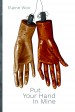
“By its final poem, Put Your Hand in Mine has flashed us through no less than eighty-six scenes depicting family, friendships between women, toxic relationships, and the medicine of the urban natural world in what feels like Vancouver, not directly named but present through the book’s alleyways, raccoons, trees, and oceanscapes... I appreciated the spaciousness of [the poems'] forms and their moments of piercing effect… Like the uncanny visual of the two wooden mannequin hands that dangle from thin wire on the book’s front cover, at inspired points the hand within surprises us with curious movement and unusual illustration.”
More Reviews of this title
“The speaker within Elaine Woo’s second full-length collection is pretense-adverse, is PC-adverse. Rather than conform to social dictates, she risks candidly addressing the theater of the personal and the social. This speaker raises her voice to systems designed to create pecking orders and power structures, e.g. office politics and sexual harassment within work environments. She speaks out against divisions among workers and the trials of the working class. She maintains a “fence-free yard.” The poems that address consumerism and materiality are among the most critical and biting within the collection, where research reveals “a rite of passage and disavowal of… [the] “Barbie Syndrome.”” The fashion industry seems the central focus of her ire; observations of what people are wearing—“distressed denim,” “colour-block shirts”—results in the judgement that the wearer “sports decay.” Observations of the natural world within the poems reveals an appreciation for its flora and fauna—spider, nautilus shell, cabbage butterfly, eagle, hazel tree, ivy. The poems also reveal disdain for exploitive acts against the Earth, such as diamond mining and the pollution of seas, where sea life tries to survive “amid deadly flotsam.” World politics, nationhood, and nationalism all are also featured subjects, where the speaker asks, “What if a new present were chiselled out, cat sheathed her claws, ceased salivating?” In a time of “An Ill Wind” and “Alchemical Fire,” a time of “No Safe Moves,” Woo’s speaker wards off “unsought advice” and reckons with the “Theater of the psyche,” while “Stoking the Siren.” Read it!”
“Elaine Woo’s journey from young childhood to gray hair is told with a close connection to the natural world, even as it succumbs to environmental degradation. She is a relentless observer who gives the reader unique perspectives on such homely natural things as a cat stalking a bird, crows gathering, or, most significantly to her, the waves washing “the hem” of the beach. Even quotidian clothing, crafted by nature and by humans, takes on purpose for the speaker, from worn denim to winter boots and an embroidered tunic.
Despite the speaker’s sustained solitude, it is the odd poem about people–her friend who was diagnosed with breast cancer, her mentor who lost the vision in one eye, her mother, her father–that define the collection with snapshot-like clarity. From poem to poem, the experience of reading is akin to looking through an old diary or photo album, though not always a happy one. It is through her relationships with people we see her grow from an impressionable girl into a woman who owns herself and her life. Her female characters, such as her mentor, prove brave independent women no matter what challenges them. Meanwhile, her relationships with women bolster her own self-examination and willingness to accept her own flaws as she works to strengthen her sense of self.
This reviewer found the format of some poems distracting as the poet sought to put her words into motion across the page. For example, the arrangement of one line on the left margin, skipping two lines, and then settling in the right margin, in actuality seemed unnecessary: the language in these poems is strong enough on its own to convey the heartbeat of the seasonal cycles riding on the waves of the ocean in which the poet finds steadfast peace when in pain. However, other readers may enjoy having this enigmatic canvas to interpret from.
In the end, Put Your Hand in Mine reads as a complicated tension between despair and hope as well as a call for women to hold hands across their differences. The Amazon Rain Forest is burning. Rafts of plastic pollute the speaker’s beloved ocean. By 2030, humans may use up all of the earth’s ability to replenish topsoil and, hence, food. Where does one find hope in the face of such realities? Woo turns repeatedly to the beauty of nature for her inspiration. It is this we poets must remember, and through our writings, speak out and call each other to accountability. ”
“Vancouver poet Elaine Woo’s first collection, Cycling with the Dragon (Nightwood Editions, 2014), had an often whimsical tone, but despite the poems that focussed on joy and the solace offered by notebooks and creative acts, the persona of this first collection struggled to withstand an onslaught of other voices which sought to define her.
Put Your Hand in Mine (Signature Editions, 2019), Woo’s second collection, shares the same edgy, whimsy, delicate observation, and careful word choice. In the prose poem “The Myth of Barbie” Woo captures many of her preoccupations in Cycling: bittersweet memories of childhood combined with experiences of insecurity and structural racism. Barbie, the poem notes,
speaks egalitarian: my friends include Hispanic Teresa and African American
Christie. Or does she? All her friends bear dubious Caucasian features. Did the
product designers accentuate their own desire as the only flight path?
The poem observes that the unreal dimensions of Barbie meant she would have had “insufficient body fat to menstruate”, and asks “Does Barbie knit vulnerability? Or punish?” The speaker notes a 2005 study which “theorized that girls reject their Barbie dolls, punish them by decapitation or microwaving: a rite of passage and disavowal of their past ‘Barbie Syndrome.’” She concludes with her own satisfyingly sly decapitation, offering kudos to her mother: “you wouldn’t allow me one, spared me ritual beheading.”
In this second collection, more of the darker tone first heard in Cycling predominates, perhaps signaled by the divergent title and cover: the phrase Put Your Hand in Mine, which appears nowhere in the collection itself and yet suggests companionship paired with solitude, is illustrated by the image of two wooden mannequin hands on wire strings; the hands make contact at only one point. In response to my query regarding the cover image, Woo observed, “I see the mannequin hands as helpless, truncated hands, unable to affect much of consequence in the world. The poet copes with the small tools in her tool belt…My hands might as well be wooden.” While we see in many of these poems that damage has been done to the individual psyche, language seeks redress with these “small tools.” The poem is described as space for the introvert to acknowledge the opacity of others, to push back against incursions, to claim a voice that has been silenced, to seek peace.
In “Escape Route” the dark space between two human beings, which is impossible to cross, is described, scored by critique and insecurity:
Upon meeting, she and I split into distant oppositional points, water skeeters
bumping and separating, as she snarls: There is more to life than looking good.
Should I cloud my face, erase the genetically given, abstract my fingernails
into cerebral claws, dumb myself to match her unsaid take on my appearance?
Similarly, in “Alchemical Fire” there is an attempt by an interlocutor to confine the poet’s persona:
the way you ‘splained it
woman’s world is small
man’s world is large
my jaw gnaws offence to particles
…
ironed pleats of loneliness
swore I wouldn’t be Hoovered
in again but my flooding eyes
betray me oxygen intake plunges…
Here we see the wonderfully precise language used by Woo: the clenched jaws which attempt to grind down the offensive assertions to fine particles, the resistance to being “Hoovered / in again” by a dominant personality, the delicately phrased “pleats of loneliness.”
While writing provides solace, animals and glimmers of the natural world also offer a peaceful retreat from the rapacious energy suck of others. The brief poem “Great Company” provides respite to the reader, in which
We see in mountain meadows
the way standing zazen cows graze
the creatures simply are
their bells faint
tails brushing.
The cows make no demands upon us. “Zazen,” or ‘seated meditation,’ is practiced by “standing” cows; the contemplative tradition invoked by the reference to Zen presents the cows to us as a koan, analogous to a poem—it cannot be puzzled out in a rational manner, but is subject to intuition, image, sound. With the phrase, “zazen cows graze,” alliteration of /s/ and /z/ suggests the chewing of grass; we hear also the faint sound of bells and flicking tails. In experiencing this poem, we “simply are.”
Despite the insistence in many of these poems upon exploring the psychic and physical violence we inflict upon one another, even in casual everyday interactions, there is simultaneously a yearning to reach out to the other. We find a gloss on the collection’s title in the final lines of “Strand” where bystanders “gaze at the tender flesh of their palms / whisper what can one hand do?” ”
“Clawing from the bottom of a well at the unforgiving stone walls of materialistic society's demands, Elaine Woo gazes longingly toward the natural world. The pressures placed upon women surface, revealing an image of malcontent that can be merely as uncomfortable as returning a pair of black jeans or as wretched as getting "Hoovered in again" by narcissistic abuse.
Despite the speaker's intermittent companions, women's suffering is magnified by their broken friendships. The veneer demanded of women tethers them to a life without depth, characterized by mutual disapproval. This reproach is typified by the speaker's mother, who "closets" her "in early death." Meanwhile, stronger bonds are lost to bullies like cancer, which seep from the contaminated earth.
Complacency with toxicity as women's lot in life evaporates at "Stoking the Sirens." Suddenly, the speaker's life is lightning struck by a horrifying attack. Most disturbing, she intuits the attack. For, how could a world teeming with noxiousness not revert to violence against women, the lifegivers? This poem exposes the underlying rage that ignites the stressors of everyday life.
I felt numb to the remaining poems as they marched on. Woo's hope lies in reconnecting with nature in the last poems, which offer empowerment and healing: "lively communion / leached through this isolate cloak." Still, I remain cynical, "wishing I could buy into that." I remember the fraught mother who must hastily abandon her "forest bathing" meditation when she realizes she'd late to retrieve her children — we try to reconnect with our natural roots and seem always to be interrupted, at times by bewildering brutality.
Yet, for Woo, reconnection with nature is our only chance. Women must take one another by the hand and re-enter the forest and the sea, if we want to survive.”
“There is no shortage of poems or poetry collections about the natural world, but Elaine Woo’s Put Your Hand in Mine renders nature unfamiliar, sometimes even frightening, and nonetheless a vehicle for human experience. Sensory details, all necessary but not uniformly pleasant, help convey lush sentiment, and blur the lines between internal and external landscapes. Known objects—horns and tails, butterflies, birds, stones, mothers, fathers and friends—form images that are simultaneously dreamy and precise. Woo’s narratives are tightly woven and poignant, and her diction is superb. Certain turns of phrase—a “devastation of flip-flops” (“Hilltop Town, Italy”) or an “entombed tree root in gravel path” (“Alternating Tones”)—throw sharp relief on things you know, but didn’t know you knew, or perhaps offer the vocabulary for you to finally articulate them.
Formally, the collection is fluid: it alternates between the highly readable and accessible, and the experimental, generating natural pauses in reading and leaving ample room to put the book down and return at another time. Visual poems mimic shorelines, hills, and archipelagos; the haphazardness of the evoked natural world and the deliberate creation of the poems’ formats play beautifully together. The collection’s curation reminds one of fossils compressed between layers of sediment, each building upon the last. The reader is rendered palaeontologist, deep-sea diver, and treasure hunter, unearthing evidence of lives lived. Emotions like love, loneliness, grief and rage turn up like precious stones amongst meditations on wildlife. “For Akiko,” for example, is a brief, piercing note on loss, the negative space on the page reminding the reader that grief cannot—and perhaps should not—always be articulated.
Between more elusive, image-driven pieces, other poems necessarily pick at and destabilize the narratives that centre the hegemonic. “Alchemical Fire” is but one poem which puts a spotlight on womanhood: “the way you ’splained it / woman’s world is small / man’s world is large / my jaw gnaws offence to particles.” Others yet interrogate the nature of borders, beauty, and class, exposing without patronizing the artifice of our modern lives. Racial tension emerges in “The Myth of Barbie.” Woo writes, “She speaks egalitarian: my friends include Hispanic Teresa and African American Christie… Teresa and Christie in Tandem: Does Barbie knit vulnerability? Or punish?” The interweaving of social discourses is subtle and makes every line worth unpacking.
Put Your Hand in Mine is a stunning collection by an obviously seasoned writer with striking imagery and clarity of voice. The poems are brief, perfect for those looking for something they can take a few bites of at a time, but they linger. Most of all, Woo demands the reader look more closely at the world around them, even, or especially, at the frightening and uncomfortable.”






 Back to top