
Review of Tablet Fragments
“Most of my favourite lyric poetry involves poems that propose broad but endlessly relevant questions. E.g., What do we carry with us of our years of experience? How do we witness our lives and of those who touch us? And how do we continue to build upon that?
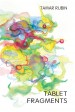
Tamar Rubin’s debut book of poems, Tablet Fragments, encapsulates these questions in her title, referring as it does to the fractured stone tablets Moses cast down in anger on seeing the children of Israel worshipping a golden calf. The children of Israel carried the fragments with them on their journey through the desert. Thus, brokenness “is an essential aspect of the wholeness of life,” as Rubin writes in her “Prologue.”
Given this frame, the author explores her own life’s fragments – a broken marriage, strained family relations, wrestling with her cultural identity, the challenges of medical practice – alongside the newer, more whole love she acquired through heartbreak and constant questioning.
Though this is a debut, Rubin’s voice is a mature one, confident and stylistically tight. Consider this description of her first husband’s view of orderliness in “Culture and Sensitivities” (p 17):
He tells me an abscess is a healthy body
sequestering infection after failing
rejection. Inflammation organizes –
platelets, fibrin skin cells like soldiers
guarding their target.
The orderly thinking of the person described is echoed in the orderly file of “infection,” “rejection,” “inflammation,” while “platelets” and “target” hold in the “fibrin skin cells.” And when Rubin comes to capture the “messiness” the same man can’t abide, rhyme and personal pain are reflected in a looser construction:
Milk left out on the counter, months
planned carefully, a bloodstain
on a perfectly good pair of panties.
The judgment suggested in the phrasing of that final line is palpable. It’s in these nuances that Rubin’s work shines.
The challenge that some debuts suffer from is a voice and structure that gets repetitive: a whole book of one-page poems using the same form throughout. Rubin dodges this effectively, mixing short and long lyric pieces with short pieces that act as statements of intent from the narrator, like these lines from the poem “Promise to Algonquin Park” (p 47):
This is my oath to trees:
I will not pine.
I will read between leaves.
I will try to find moments.
More than anything, though, Rubin expresses intimacy – both in anger and tenderness – with a sureness that is admirable. These lines from “Attachment Theory” (p 28) offer a good example of this:
When I was one, I was born
out of my mother’s back. I found memory
suspended in a fabric sack.
We used to dance, me half sleeping
while she tapped
the beat of a bo bo bo.
This is how I learned to speak:
the shake of her voice
from her breath, to my teeth.
Here Rubin combines an arresting image of being born through a mother’s memories with the sonic intrusion of that “bo bo bo” creating a mystical dancing scene. It feels that the connection/transference between mother and daughter is completed in the rhyme of “speak” and “teeth.”
I look forward to seeing what comes next for Rubin. Tablet Fragments is a remarkable beginning.”
Read the full review at Hamilton Art and Letters
More Reviews of this title
“Rubin, in her debut collection, uses biblical and medical language to explore her identities: outsider and insider; Canadian and immigrant; doctor and patient; wife and individual; child and would-be mother. The poems explore the impact of migration, the evolution of relationships, and the fragility of religious faith and scientific fact.”
Read the full review at Prairie Books NOW.
“1 - How did your first book change your life? How does your most recent work compare to your previous? How does it feel different?
After my book was published in April 2020, I stayed home from work for 6 months. I hardly saw friends or family in person. I was staying up all hours of the night, reading and writing. Our little street in Winnipeg was closed to traffic, thrumming with hundreds of pedestrians and cyclists, dawn till dusk. It kind of felt like the apocalypse.
But also, my second son, Jonah, had just been born, only weeks after my scheduled (then rescheduled) book launch. It was the height of the first COVID lockdown. I had a very energetic and under-stimulated toddler on my hands.
I don’t know if the book changed my life, or my life changed coinciding with the book. Getting it out there was anticlimactic, after so many years of hard work, but I was also strangely relieved. I had managed to safely smuggle a relic of my old world into this bizarre new one.
The clean and dramatic transition has filled me with energy and excitement for the next project. My first book was almost a decade in the making, but this next one feels more intentional, urgent, focused. Again, maybe it’s the deadly virus and impish toddlers lurking in the background.
2 - How did you come to poetry first, as opposed to, say, fiction or non-fiction?
I think I was born wired that way. I think in poetry. When people talk to me, I’m listening to the rhythm of their words, rearranging sounds and phrases in my mind. Visualizing how the sounds would fall onto a page.
3 - How long does it take to start any particular writing project? Does your writing initially come quickly, or is it a slow process? Do first drafts appear looking close to their final shape, or does your work come out of copious notes?
My style is intuitive, flowing. The poems come out quickly. I edit them just as fast, multiple times over, over years and months. Sometimes the earlier versions work better, and sometimes the final version is unrecognizable from the first.
4 - Where does a poem usually begin for you? Are you an author of short pieces that end up combining into a larger project, or are you working on a "book" from the very beginning?
So far I am only one book in, so it’s hard to say. This recent book grew out of many shorter pieces that came together. The next one is a more focused project.
5 - Are public readings part of or counter to your creative process? Are you the sort of writer who enjoys doing readings?
I am an introvert at heart. I also love to see the words on a page when I read other peoples’ poetry, and sometimes my own work is quite visual too. I think slowly, and I’m always trying to catch up with the last metaphor when I’m listening to others’ readings. So I feel like something is lost in a live reading. I prefer to sit down with a book and digest it slowly. That being said, sometimes the exercise of reading a poem out loud in front of an audience has unearthed flaws in the piece, or elicited useful feedback that subsequently led to improvements.
6 - Do you have any theoretical concerns behind your writing? What kinds of questions are you trying to answer with your work? What do you even think the current questions are?
While studying medicine, I learned about the concepts of “narrative reflective practice” and “critical reflection.” These ideas have always resonated with me, and so in my own writing I am trying to construct and deconstruct stories. What makes people see things the way they do? What makes people act the way do?
7 – What do you see the current role of the writer being in larger culture? Does s/he even have one? What do you think the role of the writer should be?
The writer is a spiritual leader: a person who can draw people away from loneliness and toward communion. It does not matter what the story is about, or even if that story is part of your accessible experience as the reader. The writer unlocks worlds, teleports you into their beauty, or banality, their vulnerability and their power. A writer is anyone who can do this.
8 - Do you find the process of working with an outside editor difficult or essential (or both)?
For me it was a wonderful experience working with my editor, Clarise Foster. She challenged me and then challenged me some more. She was usually spot on in her assessments, and my work emerged stronger, as a result. I am always profoundly grateful (and also amazed) that someone is actually willing to sit down and analyze my work so carefully.
9 - What is the best piece of advice you've heard (not necessarily given to you directly)?
I read somewhere that there should be two criteria for deciding when to say something: 1. Is it kind? and 2. Is it necessary? Whenever I’ve messed up, it’s often because I didn’t adequately consider these questions. But I’ve also learned as a writer, that sometimes, even when things are not kind, they are necessary.
10 - What kind of writing routine do you tend to keep, or do you even have one? How does a typical day (for you) begin?
I’m currently in a challenging (but also wonderful) phase of my life where my full-time medical practice and (full-time) motherhood have superseded any other structure in my life. These days I’m up at (or before) the crack of dawn, and I sleep as soon as my kids fall asleep. I’m a pretty disciplined person in general, and so I’m hoping that once my kids figure out how to read, or at least sleep, I’ll get back to a regular hour or two of writing every morning or evening. At the moment, I write when I can!
11 - When your writing gets stalled, where do you turn or return for (for lack of a better word) inspiration?
I read great writers. I get myself to Algonquin Park (or Lake of the Woods, more recently). I go to work and I listen to peoples’ stories.
12 - What fragrance reminds you of home?
Lilacs.
13 - David W. McFadden once said that books come from books, but are there any other forms that influence your work, whether nature, music, science or visual art?
I read a lot of medical literature. I talk to people about their health. I studied science and math before I became a doctor. Sometimes when I write a poem, I feel like I am balancing a complex equation, making each word and sentence add up when read up and down, or left to right.
14 - What other writers or writings are important for your work, or simply your life outside of your work?
Here are a few, in no particular order: Alice Oswald, Edward Jenner, Leonard Cohen, the Hebrew Bible, Rita Charon, Ocean Vuong, Ken Babstock, Shmuel HaNagid, Yehuda Amichai.
15 - What would you like to do that you haven't yet done?
Dance at my childrens’ weddings. Will there even be weddings then? Will they even want one? I’d also love to take some formal literature courses. I fantasize about going back to school on a daily basis.
16 - If you could pick any other occupation to attempt, what would it be? Or, alternately, what do you think you would have ended up doing had you not been a writer?
I feel pretty lucky to have two wonderful jobs. I can’t imagine doing anything else right now. I always wish there was more time in the day.
17 - What made you write, as opposed to doing something else?
I know that double negatives are bad. But I can’t not.
18 - What was the last great book you read? What was the last great film?
Last great book: Tell them it was Mozart, by Angeline Schellenberg. Also: Difficult Women, by Roxanne Gay. I don’t think I’ve sat through more than a few minutes of a movie in a few years.
19 - What are you currently working on?
I’m working on a series of “genetic poetry,” exploring such things as how experience integrates into your DNA, and how your immune system forms memories.”
Read the full review at Rob McLennan's Blog.




 Back to top