
Review of The Octopus and Other Poems
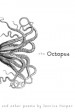
“Fascination with and the examination of the "science of everyday life" are the subjects of The Octopus and Other Poems by BC poet, Jennica Harper. Harper's speakers are innocent, questioning explorers, desirous not only of the uncharted terrain but also of the experiences on the journey itself.
Filled with investigations of love, travel, and other human behaviour, the collection speaks to the need to relate, identify, learn, and belong through a process of expression and reflection. In "Breasts: Case Study," the speaker recalls her reaction toward her breasts at the age of ten, "the blobs on my/chest just extra weight,/jacket pockets filled/and turned inside out" and compares them to her mother's that "continue to face forward./They know the way." in "Screw Roses," the speaker waits her turn at the tattoo parlous, admitting she wants to be a "bad girl, hanging out/with the mean guys, loyal but unpredictable,/adored, adorned,/leader of the pack/(vroom vroom)."
Harper writes of lost men, sea life, maps, and music, and although some of the narrative poems tend to sprawl, the metaphors and imagery, largely exploratory and scientific in nature, provide tension and feeling. Harper's work is engaging and promising.”
More Reviews of this title
“Although Jennica Harper's first book is entitled The Octopus and Other Poems, The cover of the collection somewhat misleadingly shows the tenacles of an octopus, the most prevalent motif in the poems concerns space travel. In fact, The Octopus opens with an epigraph about the Voyage expeditions to Jupiter, Uranus, and beyond. However, the two seemingly disparate notions are perhaps linked. The epigraph draws attention to teh sense of discover that is prevalent in the collection, which explores both beneath teh surface of what is seemingly apparent and outwardly into the unknown, probing what is already there and what is distant.
The word that captures the essence of The Octopus is 'unearthed' which Harper uses in a poem from late in the collection but with also resonates through the rest of the poems. In 'His Version', the speaker explains how a piano player progressed from 'tinkering' on a piano 'like the cat tiptoeing along/the keys' to '...chords/that sounded right,/like something prehistoric/he had unearthed.'
This particular poem reveals the disappointment of having that sense of discovery stifled, but more importantly, perhaps, the poem implies that there is a connection between discovery as something that is made by digging into what is present and needs to be found and discovery as something that takes people away from the known, the boundaries of their worlds.
The importance of going beyond the known is made even more apparent by the titles that Harper gives to the five sections of the book: Horizon, Maps, Space junk, Known Space and Aerial. The desire to 'launch forward,/arms out, groping/in darkness' is evident in the opening poem, 'If Roberta Bondar Were My Mother,' and in the next poem, 'Leia: A Star Wars Love Poem,' the speaker fantasizes about saving Princess Leia: 'I would follow her anywhere, chase her across/galaxies, trying to hold on to my cool. Her cool.' Although the speaker feels somehow 'counterfeit,' that she is only pretending to be like Leia, the poem helps to establish a pattern of desire to go beyond the self, to explore new worlds. But Harper apparently recognizes that flights of imagination, or even flights beyond the realm of conventionality, can be dangerous. 'Tether' is a tribute to the persona's brother, who, in his role as 'a controller//of all flying objects,' protects the persona from 'balls of fire.' As her tether to the world, he keeps her grounded (in the most positive sense) and even seems to be the ground control that makes flight possible.
In 'The Octopus', the speaker makes another reference to the Voyager expeditions, drawing an analogy between the missions to carry 'greetings/from Earth' and her own attempts to communicate with a former lover: 'Our lives orbit discretely these days, seldom intersect.' The lover 'can't condone the reckless hope/of finding some other life out there./Can't fathom the waste.' He is much more willing to study 'the octopus: its alienness,/its total lack of likeness to our own bodies.' Perhaps the irony of the poem is that while the two people hold conflicting views they do at least communicate those views to each other, though ultimately the two apparently agree to disagree about the value of the Voyager missions and about their own attempts to reconnect: 'A sigh.//You tel me I'm afraid all this probing/will have been a waste./That we are walking with a flashlight/down empty halls.'
While each perspective is in its own way valuable, together they will not provide 'a cure for loneliness,' at least not hte loneliness that the speaker is apparently feeling, and ultimately Harper's collection reveals disparate and perhaps irreconcilable ways of looking at the world.”






 Back to top